
|
 |
 |
 |
 |
 |
 |
 |
 |
 |
 |
|
You have heard the expression "third time is a charm", it is meant to be lucky saying. There are many explanations as to the origin of the expression, all having to do with the thought that the number three is lucky. For
John "Babbacombe" Lee, a convicted murderer of the 19th century, three was his lucky number. The British government attempted to hang him three times, and three times he survived, after which his sentence was commuted to life in prison, but he was released in 1907. The number three is also associated with bad luck, you have heard the expression "three on a match", the origin if which is dubious at best, but it is usually stated that the term came from the Great War or before. The legend is that if three soldiers lit cigarettes from the same match, this would give an enemy sniper time to sight in and kill the third man. (As if smoking was not hazardous enough!) For HMHS Glenart Castle three would definitely be an unlucky number. On Sept. 20, 1900 the yard of Harland & Wolff in Belfast launched a 6,700 gross ton ship for the newly formed Union-Castle Line, her name was Galician. She was over 440' long, could carry 266 passengers and would be able to make 12 knots. When she was completed in December of that year she was put into service between the U.K. and South Africa. In fourteen years of service nothing of any great importance seems to have happened to her, but during the Great War this typical ship would see a lot of action. Her first encounter occurred on Aug. 15, 1914, shortly after the war had begun. She was en route from Cape Town to the U.K., with a stop off Portuguese West Africa and then on to the Canary Islands for coal when the newly converted armed merchant cruiser SMS Kaiser Wilhelm der Grosse overhauled and captured her. Ultimately because of the number of women and children aboard the Germans released the ship. On Sept. 30, 1914 Galician was requisitioned by the Admiralty for use as a hospital ship and renamed Glenart Castle, she was fitted with 453 beds for wounded men and supplied with a full medical staff. She plied the channel carrying the wounded between the continent and England for over two years without incident. Her second encounter took place on Mar. 1, 1917, she was returning to Southampton from Le Havre when she struck a mine laid by SMS UC-65, the lucky ship was badly damaged, but there were no casualties and the ship was towed to Portsmouth for repairs. She was lucky to get there as her stern was almost below the water when she arrived. However she was repaired and placed back in service, and sent to the Mediterranean to continue her mission of mercy. In Feb. of 1918 she was back to cross channel voyages. In the early morning hours of February 26, 1918 HMHS Glenart Castle had just entered the Celtic Sea after leaving Newport (Wales) en route to Brest to pick up more wounded, she was sailing with only her crew and hospital staff. Since she was a hospital ship she was fully lit for all to see, her white hull and large crosses painted on her sides made this ship unmistakable from other ships. At about 0200 hrs. Kapitänleutnant d. R. Wilhelm Kiesewetter and his UC-56 sighted the ship approaching Lundy Island. Kiesewetter later claimed he watched the ship for over an hour and a half and saw only a few small lights on the ship and believed her to be an armed merchant cruiser. With the ship being totally illuminated from stem to stern, which was confirmed by several witnesses, it is difficult to believe he could not identify her as a hospital ship. He submerged his boat and moved into a firing position. He looked through his periscope at the target, the first and last ship he ever sank, made the calculations and fired his torpedoes. At about 0400 two torpedoes slammed into the Glenart Castle on her starboard side, almost immediately all power was lost and all lights went out, the ship was plunged into darkness. They did not know, but the ship would be gone in seven minutes, and in those few minutes there was no time for the orderly launch the lifeboats and get all those onboard to safety. One boat had been destroyed by the explosions, others had much difficulty getting into the water, however seven boats were got away, but only one was ever found. Most of the people on the ship were inside, probably sleeping and had little chance of getting off after the lights went out, a dark and rolling ship, sinking fast and listing hard makes moving about almost impossible. Add to that the adrenaline pulsing through your veins from fear, the panic from the thought of death and the sad fact is that only those who were awake, alert and on deck or close to an exit had any chance at all. She sank stern first taking a number of her charges into the depths with her and leaving many others in the cold and churning waters. Heavy seas were running, rollers about 20' high were reported and this made searching for others almost impossible. Survivors could hear the cries of those in the water, but the voices soon faded as the cold took them one by one. Several hours after the sinking the first survivors were found by the French schooner Faon, the twenty-two cold souls were taken aboard and well treated by the Frenchmen. The ship remained in the area for two hours, but was unable to locate any other survivors so they made their was to Swansea arriving on the 26th. The most dramatic rescue occurred at about 1300 hrs that afternoon when USS Parker DD-48 arrived on the scene. They had received a signal about the sinking and Cdr. Halsey Powell, U.S.N. made all haste toward the area. When they arrived they sighted a man on a raft, and unable to stop due to the threat of submarine attack, a line was thrown to him. He grabbed the line, but was too weak to haul himself aboard. As the ship moved through the water he was dragged toward the stern and was mortally injured by the propellers. The Quartermaster jumped overboard and recovered him, but he died onboard from his wounds. In all nine survivors were pulled from the water by the men of the Parker. Several crewmen jumped into the cold water and pulled the survivors to the ship one by one. The heroic rescue was recognized by Parliament the following month. It seems that none of the American seamen were decorated by the U.S. Navy, even though the Admiralty and the British government expressed their desire that this be done. The men who risked their lives saving the survivors were; Quartermaster J. C. Cole, Boatswain's Mate R. E. Hosses, Machinist's Mate David Goldman, Coxswain Jerry Quinn, Yeoman F. W. Beeghley, Ship's Cook W. W. Matthews, Seaman J. Newman and Seaman T. F. Troue. Only seven other survivors were picked up, they were landed at Pembroke. The total number of casualties was about 155, including all of the nurses and sisters serving aboard. When this was learned the Bishop of London said "The cries of the drowning nurses will echo in our ears forever". Since the power went out just after the torpedoes struck there was no distress signal sent, but at least one trawler had seen the ship and had seen the lights go out abruptly, but the crew later stated that they did not know that the ship had been sunk, just that the lights had gone out. They also claimed to have seen a submarine submerge some distance away from their craft. At least two survivors also claimed to have seen the submarine after the ship went down, they were not molested, but the submarine offered no assistance to those in the water. Days later a report circulated through the press that the survivors had been machine-gunned in the lifeboats and in the water, this was later proven to have been a false report, a fact that even the British at the time acknowledged. Kiesewetter and his submarine stole away and returned to Zeebrugge, they never sank another ship. In a post war interview he said that after the sinking he stayed submerged until until 0730 hrs., and that when he surfaced he picked up a wireless signal stating the ship he had sunk was the hospital ship Glenart Castle. UC-56, with Kiesewetter still in command, was later interned in Spain after arriving in a state of disrepair. He was arrested in Falmouth on May 6, 1919 while attempting to return to Germany and imprisoned in the Tower of London. However he was released two weeks later because he carried with him a letter of safe conduct from the French Ambassador in Madrid. The British authorities, including the Foreign Secretary Arthur Balfour, decided that the safe conduct letter trumped the British arresting him as a war criminal. He was supposed to be surrendered by Germany if demanded by Britain, but when the time came he was nowhere to be found and was therefore not tried at Leipzig. Kiesewetter kept a low profile until the next war when he was made commanding officer of the training boat UC-1, becoming the oldest U-boat commander in history at age 62. On Feb. 26, 2002 a memorial was dedicated at Hartland Point, Devon in memory of those lost in Glenart Castle. |
© 2012 Michael W. Pocock MaritimeQuest.com |
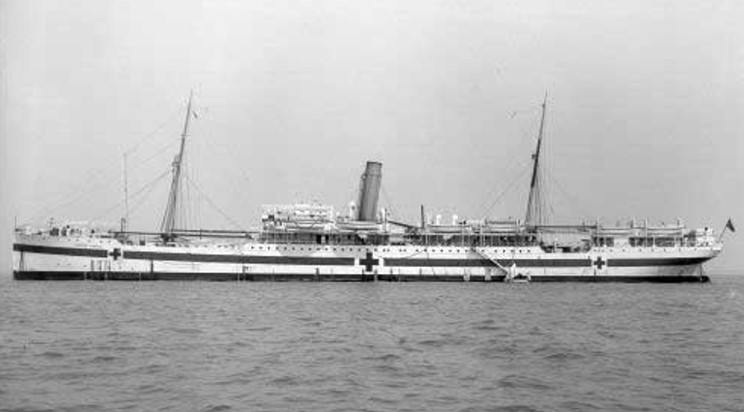 |
HMHS Glenart Castle. |
To submit a photo, biographical information or correction please email the webmaster. |
2005 Daily Event |
2007 Daily Event |
|
2010 Daily Event |
||
2011 Daily Event |